Before discussing the need of financial wellness programs in the workplace, it is crucial to understand what financial wellness is. Many employees, especially at the start of their career, tend to struggle to curtail their expenses, and end up trapped in what is called paycheck-to-paycheck living. The result? Scenarios where the employee’s monthly outflow of cash is almost as much as the monthly inflow, leaving little room for savings or emergency funds. Financial wellness implies a situation where an employee is living well within his or her means and is able to keep an emergency fund to allow for stressful situations by taking little or no debt. It’s financial independence, in short.
With increasing general awareness about different investment products and management of personal finances, it has become somewhat easier for individuals to achieve their long term financial goals. Most individuals today understand the need to start saving early, thereby reducing the number of money related stressful situations in the future.
But in today’s era, financial wellness is not just a concern for employees but also for their employers. Why?
When employees are experiencing financial hardships, they’re very likely to bring that stress into the workplace, and come into office worried and unable to concentrate.
Even when they’re working the stress shows up in their work and their health, driving down productivity and increasing health costs – reason enough for employers to consider offering advice in this area.
Organisations with the foresight to acknowledge this issue are proactively introducing their employees to financial wellness programs and money management tools as a part of their work culture.
Being invested in an employee’s financial wellness also ensures that the employee remains loyal and is hitched with you for the long term thus, reducing employee turnover.
The Society for Human Resource Management’s (SHRM’s) Employee Benefits Survey conducted earlier this year has revealed more organisations to be offering financial advice and financial wellness programs as compared to five years ago.
Additionally, gone are the days when simplistic retirement benefits and insurance covers were adequate to attract and retain talent. For today’s generation, it is comprehensive compensation and benefits plans which include holistic financial wellness programs that are closing the gap.
Check out the 2018 Employee Financial Wellness Survey by PricewaterhouseCoopers (PwC) for more insight into the why’s and what’s on financial wellness for employees.
It is crucial, however, for organisations to be cautious of becoming over-invested and to not make the mistake of pre-selecting financial products or services for employees. Every employee and type of workforce can have different needs, both for themselves and their families. Employees could be on different places on the spectrum of financial wellness. It’s important to offer them options and not a sales pitch, allowing them to exercise discretion and autonomy to the extent possible.
Consumerism is at its peak, globally. Sales are no longer restricted to the festive seasons. With e-commerce portals announcing significant discounts almost all the time, turning away is not an option. Print and digital media are flooded with the best ever online sales, and almost everything you want is cheaper than ever. From clothing to accessories and from electronics to groceries, you ask for it, and they have discounted it. You just cannot ignore it.
We all browse to hunt down the best deal. However, do you end up leaving items in the cart or remove items during checkout because of a cash crunch? Shopping needs a reasonable budget, and sometimes we give in to our desires, affecting our monthly budget. Whatever the reason behind your money hues be, there is one feasible borrowing option available 24*7, and that is EarlySalary’s collateral free instant cash loan.
Any salaried individual can avail an online personal loan through Fibe app. Zero cost EMIs allow individuals to buy a host of products by making nominal changes to their budget. Given the possibility of the higher inflation rate and unexpected expenditures, paying in EMIs is a smarter choice as this way you don’t block cash.
Unique Features of EarlySalary’s Instant Cash Loans
Easy Application and Disbursal
Sales on your favourite item are available only for a small window, which is where quick loans come handy as they are fast in disbursal. You have to upload your address and identity proof with the bank statement of the last three months on the app. The loan will be disbursed within 8 to 24 hours of your application. The process is entirely online and hassle-free.
2.Spending Freedom
Technology is ever-changing, and given our growing dependence on it, the need to switch and upgrade is imperative. From getting brand new kitchen appliances for your mother or wife to buying new gadgets for yourself and to gifting your loved ones, an instant cash loan can be used for any purpose.
3.No Collateral required A common man may not have a property but certainly has desires. This point makes a cash loan an ideal option for those who do not have a security. There is no need to put any of your assets on a lien or submit any paperwork.
4.Zero-Cost EMIs
An instant cash loan is an affordable short-term loan. With EarlySalary, you can shop for your favourite product on Amazon and pay in 3 EMI at zero extra cost. You can also repay in 6 EMIs with a nominal charge of Rs 500. What’s even better is that all EarlySalary users can avail exclusive offers in Amazon sales.
Online shopping has never been easier. EarlySalary’s tie-ups with e-commerce giant Amazon, retail giant Future group’s BigBazaar, etc., have made online shopping more convenient. Once you have an approved credit limit, you can get it fully or partially transferred to your Amazon pay within the EarlySalary app.
Similarly, EarlySalary transfers credit to your Future pay wallet. This credit can be used to shop at any Big Bazaar store. You can repay in 3 EMIs at zero extra cost.
2. Attractive Offers
Online offers are great but what if you get exclusive discounts too? All EarlySalary users get additional offers such as cash back, flat off, up to off, coupons, etc. when they shop online.
3.Choice
Cash crunch may restrict the choices you have and force you to settle for less. However, with EarlySalary’s tie-ups with major retailers like BigBazar, you get a wide range of options to choose from. You can shop across brands at the comfort of your home, office or cab online or through apps. So be an intelligent shopper, save more with zero-cost EMIs and shop even more. The next time your cart is full, but the wallet is not, get a SalaryAdvance from Fibe and improve your lifestyle.
Payday is great! You’re all pumped up with the replenished account balance and ready to celebrate with gourmet meals, shopping, a new Marvel movie, and more. It’s finally that time when you can move items from the wishlist to the cart and tick items in your bucket list. Pause.
But, it’s also time to face some facts. Well, you may not want to, but the celebration may not last until the next payday despite conscious budgeting. As we approach the month-end, a sinking feeling outstrips your joy and slams you with the bill you forgot to account for. No doubt it hits hard, but this may just be the beginning of the month-end money crunch if a financial emergency crops up. After all, misfortunes never come alone. Your paltry balance after overspending may pinch you with fuel refills, medical emergency, last-minute travel plans, repairs, etc.
Let’s weigh your options
Beg, Borrow, Liquidate: Undoubtedly, borrowing is the easiest option but may also be the most embarrassing. What’s worse is that your potential lenders, too, might be in a similar situation. You might not want to ask your parents because they have already given you a significant chunk of their savings for your top-notch MBA degree (or similar). This is fair because it might only burden them more. Liquidation may not be viable if the bears dominate the market.
Ask the Employer: Some organizations have a policy for an early paycheck. However, this is subject to several conditions and one may not be even eligible for this during the probation period. Also, it depends on your designation and purpose.
Personal Loan/Credit Card: Rigid repayment terms and payment failures may reduce your credit score. This negatively impacts your future borrowing capacity. Another challenge is the requirement of a high credit score. None of us have a decent credit score at the outset of our professional career. You may not be eligible for a personal loan or may have an insufficient and low credit limit.
Are you already on the horns of a dilemma? Don’t fret, this isn’t a Hobson’s choice!
What should you choose?
There is one hassle-free option that ranks better than all the options above and can allay your month-end money problems in a day. The best option available to all salaried individuals is a short-term, collateral-free instant salary advance. This option will save you from the embarrassment of asking friends and relatives and also the exorbitantly high interest rate on other available options. Salary advance apps like Fibe offer the benefits of quick loans, available 24*7 through the Fibe app. It can be availed by all salaried professionals even with a low credit score.
Why only EarlySalary’s SalaryAdvance?
⇒ Low-interest rate
A Salary Advance is a cost-effective solution to cover your month-end financial problems. In fact, there are no hidden charges, you’ll only be charged for the number of days you use the money. You can prepay the entire amount without prepayment charges.
⇒ Flexible Repayment Terms
Fibe’s Salary Advance can be used for any purpose, and this includes your rejuvenating spa too. You can repay in easy EMIs over a period varying from one month to one year.
⇒ Zero Paperwork, Quick Disbursal
Just download the app, upload the bank statements of last 3 months, address and identity proof and voila, your application is all set for approval. EarlySalary disburses loans within 8 to 24 hours of online documentation and approval.
Don’t miss a big sale or bail out on that road-trip with your friends over the weekend and just wind-down. You deserve it. So, all you cash-strapped professionals, take an instant salary advance, ward off the end-of-month blues and stay in high spirits!
Sudden expenses can come up anytime. It could be a medical bill, rent, travel booking or a simple cash shortfall before payday. In moments like these, you may wonder how can I get a loan fast or how to get instant loan without paperwork delays.
Today, digital lending makes this possible. With online loan platforms like Fibe, you can apply for a personal loan, get approval and receive funds in just a few minutes. The process is fully online, simple to use and designed for quick access to money when you need it most.
Personal Loans in 2026: What’s Changing?
Personal loans have evolved with digital lending. In 2026, borrowers prefer speed, convenience and transparency. Online loans are replacing long branch visits and paperwork-heavy processes.
Most lenders now use digital verification, instant eligibility checks and automated approvals. This shift makes it easier to understand how to apply for personal loan online and receive funds faster.
Online vs Offline: Which is the Better Way to Apply?
Factor
Online Personal Loan
Offline Personal Loan
Application process
Fully digital through app or website
Branch visit required
Time taken
Minutes
Several days
Documentation
Minimal
Extensive
Approval speed
Instant or near-instant
Slow
Convenience
Apply anytime, anywhere
Fixed working hours
How to Get a Personal Loan in Under 5 Minutes?
Follow these steps to understand how to get a personal loan online:
Step 1: Download the Fibe app or visit the website
Step 2: Enter your basic details
Step 3: Upload required documents
Step 4: Check your eligibility instantly
Step 5: Get approval and receive funds
This is one of the fastest ways to understand how to apply for personal loan without delays.
Eligibility Criteria to Get a Personal Loan in 5 Minutes
You should be salaried and employed for at least 3 months
Your monthly income should meet minimum requirements
You should have an active bank account
Meeting these criteria helps you get faster approval and shows how can I get a loan fast.
Documents Required for Fast Processing
Keep these documents ready to avoid delays:
Identity proof
Address proof
Bank account details
Salary or income proof
Having documents ready makes it easier to understand how to get instant loan approval.
How Instant Personal Loan Gets Approved in Minutes?
Instant personal loans are approved quickly because lenders use digital checks. Your application is assessed using automated systems that verify identity, income and repayment behaviour in real time. This removes manual checks and speeds up decisions. That is why digital lending platforms can offer approvals in minutes instead of days.
Factors That Can Slow Approval
While instant loans are fast, some factors can slow things down:
Incomplete or incorrect details
Missing documents
Bank account verification issues
Low credit score or inconsistent income
Avoiding these helps you get funds faster.
Tips to Improve Approval Chances and Speed
Use these tips to improve approval speed:
Enter accurate details
Upload clear documents
Maintain a healthy credit profile
Avoid multiple applications at once
Ensure your bank account is active
With Fibe, you can get an Instant Personal Loan of up to ₹10 lakhs in just a few minutes. Download the Fibe Personal Loan App to enjoy quick, easy and hassle-free access to funds.
FAQs on How to Get a Personal Loan in Less Than 5 Minutes
What is the disbursement period for a personal loan?
If you are wondering, ‘How much time it takes to disburse a personal loan?’, the answer is that it varies depending on the lender you choose. Fibe takes only a few minutes to approve and disburse your loan.
Where can I borrow money in 5 minutes?
You can borrow money through digital lending platforms like Fibe. These platforms allow you to apply online, get instant approval and receive funds within minutes.
Can I apply for a personal loan online if I already have another loan?
Yes, you can apply for a personal loan online even if you already have another loan. Approval depends on your income, repayment history and overall credit profile.
Millennials largely depend on credit and borrowed money, far more than the preceding generations. Weekend vacations, buying a car or even sudden shopping trips may often not fit into their monthly salary. Financial institutions have long identified this problem and come up with several alternatives depending on the amount you need to borrow, the income rate and the risk associated with lending you the money. The market has pushed credit cards, personal loans and the like to serve millennial needs – but there remains one large issue – the interest rates these institutions seem to charge.
What are interest rates and how do they work?
Interest is essential for a rental charge for borrowing money. If the risk involved in lending money is low, a low-interest rate will be charged. Individuals may borrow money for a host of reasons – from business funding to paying college tuition. Money that is borrowed can be paid back wholly in a lump sum or in instalments in a periodic manner. The interest levied is given in the form of a percentage which can be charged simply or in a compounded manner.
Take the concept of simple interest – if someone takes a loan of ₹ 30 lacs from the bank as a loan agreement in order to build a house and the interest on the loan is 15%, then the borrower will end up paying 15% of ₹ 3 lacs for each year.
Interest rate per year = 15% x ₹ 3 lacs = ₹ 45,000.
Hence for each year that you do not pay back the money, you end up spending ₹ 45,000 more interest. This explains how banking corporations make money by lending. Often, lenders prefer to charge interest in a compounded manner, which is interest on interest. This kind of interest is mostly practised on money borrowed for a short amount of time, such as money borrowed through credit cards. Sometimes, the calculation of interest through simple and compound is not too different in an extremely short time frame. However, as the lending time increases, the difference between simple and compound interest also grows. Hence people are always advised to pay off their credit card bills as fast as possible.
Interest rates on Credit Cards
Credit cards levy their interest through a standard interest rate called Annual Percentage Rate, or APR. The percentage rate depends on a number of factors, such as credit score and the bank from which you have issued the credit card. Credit cards use the APR to calculate the interest charges over a monthly period. The APR can also be used to compare the different credit and loan offers from various banks, helping you choose the best fit for yourself. The APR takes into account other charges, such as the arrangement fee. Hence sometimes, it is different from the interest rate.
Credit card interest rates can seem (and are) significantly higher. This is because interest is charged regularly on any remaining balance from a previous cycle and because the rates themselves are fairly high – often as high as 40% annually!
Interest rates on Fibe
With interest rates soaring and millennials borrowing more than they can pay back, a significant portion of India’s population is in constant debt. This naturally impacts credit scores and raises the need for a simpler method of borrowing without much interest. While personal loans seem like the perfect answer to borrow money for personal needs, they demand a strong credit score if you do not want to take that hefty loan at a larger interest rate. Instant loan app services have recognised this gap and have started giving out salary advances at a nominal interest rate. Fibe, for instance, lets you borrow up to ₹ 5 lacs charging interest only on the number of days you use the money at an interest rate as low as ₹ 7/day. The process is a lot simpler than other bank procedures, with instant approval and money transfer within hours (and sometimes minutes). The process is completely digital, where you need to upload soft copies to complete the identification process. Even the repayment process is hassle-free since money is automatically debited from your account every month.
Since the salary advance from Fibe relies on a combination of your credit score and what it calls your social worth score, young employees who have just started working and do not have a strong credit score need not worry too much.
Simply put, Fibe is the answer to your month-end cash crunch. From a Salary Advance to shopping needs, Fibe has everything covered. Don’t stop living!
By : Dhruv Anand – AVP & Head Talent Management, Netmagic Solutions
In today’s times of intense career mobility and attrition, if an organization does not give its employees enough reasons to stay, or worse, gives them reasons to leave, employees are fairly likely to move to employers who will keep them happier. While employee engagement is quantified in various methods but very limited correlation to financial performance, Employee Engagement certainly has a huge impact on the finance of any organization or business. Employee engagement, and how it is handled could differ from company to company. While a lot of organizations want to see their employees content and satisfied, some top-tier companies strive hard to keep the enthusiasm of their workers alive.
How does employee engagement affect the company finances?
Even before entering into the workforce,
prospective employees have a certain vision of the place they would like to
work at. The atmosphere and treatment meted out to employees plays a
significant role in attracting workers. All industries are experiencing a
stronger need to prioritize their workplace culture in order to retain their
best talent. A disengaged and disgruntled workforce can damage the culture.
Financial drainage is also seen in the form of salaries and benefits given out
to these employees. Such employees are more likely to leave the company making
it necessary to find replacements. This is a triple blow to time, money and
productivity of the management.
An engaged workforce, on the other hand,
reduces financial drainage and positively impacts the business. There is a
reason why top companies like Google and Facebook focus on non-cash rewards
such as flexibility, work content and a comfortable office space with activity
centres. Your environment acting as an engager and a good work environment is
often fundamental for employees to work without too much stress, in turn
increasing their productivity and thus financial revenue.
Retaining your best people through financial benefits and compensations
In addition to the base salary, it is
important to show your employees that there are other monetary benefits and
rewards for them in the organization. Smart employers are aware that keeping a
high quality employee comes with a high compensation and benefit package, which
is worth every penny due to the superior value delivered. Financial benefits
sweeten the employment contract with surprises workers wouldn’t generally
expect.
It is also critical to ensure proper
communication with your employees. While financial benefits are important, a
homely and comfortable work environment along with recognition goes a long way
in helping retain your best workers. Employees often talk about their holiday
bonuses or follow their stocks closely because they have stock options. This
kind of compensation also gives the workers a stronger sense of satisfaction
when the company succeeds.
The role of financial literacy and financial wellness
Economic and monetary issues have become
very critical for today’s employers. Millennials are spending as much time as
they can at the workspace in order to pay their bills and debts for even the
most basic utilities. This increasing amount of stress often ends up hampering
their productivity and lowers engagement inspite of best efforts from employer.
With this mounting stress and uncertainty, organizations are now playing an
active role in easing the financial situations of their employees through a
variety of possibilities, sometimes through the forms of rewards. This could be
through food vouchers and coupons, sponsored trips with family inorder to
destress during the weekend, or even movie tickets.
These factors have gone a long way in
motivating employees, easing their situation and ultimately retaining them.
Organizations have realised that helping their workers in turn boosts their
revenue, thus making it a win-win situation.
With millennials’ increasing dependence on credit options in order to live their life, financial education is more critical than ever. While financial literacy has of course, a directly positive impact on employees, it also benefits employers is more ways than you may imagine. Strong financial education and better financial management skills result in employees less likely to end up with financial woes and stress – or in other words – more likely to end up as increasingly productive parts of the workforce. Lower attritions are a consequence as well if there are fewer financial hardships and fewer requests for salary advances to deal with. Financial stress can affect the workplace in many negative ways, by directly impacting productivity and causing more anxiety at the workplace.
Educating employees about their finances is also a good way to exhibit a truly people centric organisation culture – the organisation moves forward if its people move forward.
New Joinees: The Basics
Companies are often seen hiring new employees during a certain time of the year (and sometimes even throughout the year), be it through on-campus hiring, or off-campus drives.
As the business scales, manpower needs obviously increase. When a percentage of the workers retire or graduate to managerial positions, young graduate students are often recruited to fill this gap. Younger employees tend to be more enthusiastic, with stronger learning ability and are more up to date with current technology. They also have fresh ideas and newer perspectives that can bring an added value to the organisation. They also do not tend to cost the company as much.
Sometimes, employers hire a certain group of people due to their unique skill, such as a cloud computing specialist, or a web developer. Their ability to do the work in a short amount of time with great efficiency reduces the overall cost to company and increases their profits.
Thanks to the digital age, recruitments are not as tedious for the employers as they used to be. With job roles becoming more specific even at the lowest level, candidates are screened out automatically. While online recruiting is very effective, it is also important that your new hires transition into their workplace effortlessly.
The Criticality of Financial Wellness For Employees
Employees spend a third of their day at their workplace. Naturally then, it is critical that they look forward to it – and that is accomplished when the organisation is careful to cater to their needs – physically, mentally and financially. The three are often very closely connected, however, employers are often significantly responsible for financial wellness:
Funds play a very important role in their lives and a lack of them is likely cause a number of problems, including disruption of physical and mental health.
With increasing stress and workload at workplaces, employers are now taking the financial wellness of their employees more seriously. The average worker today, before even starting their job, typically brings with them significant debt in terms of college loans and personal loans that need to be paid off.
Organisations have fortunately begun taking an active interest in improving the everyday financial situation for their employees. This need not be directly in the form of money. Food vouchers, sponsored trips or even simple spa and movie tickets are given out regularly as morale boosters.
A Good Financial Start
Benefits and bonuses are a lot more regular and simple now with the onset of the digital era.
Employers have tried to lighten any financial burden through tie ups with online loan apps or extending personal loans and salary advances themselves.
Companies are also issuing corporate credit cards to reimburse any excess expenses carried out by the employee for the organisation. This could include travel expenses and client meals.
Several banks, including State Bank of India, and ICICI Bank have extended their support to a prepaid card model. Expense management brands have also created prepaid cards for business purposes, so employers can get their money reimbursed easily.
Companies have come a long way as far as financial wellness is concerned, from team outings to regular bonuses and festival gifts, employers are going out of their way to ease the financial stress of their employees by fulfilling experiences. Tie ups with leading salary advance apps, such as EarlySalary also ensure that workers can obtain salary advances and personal loans at an affordable interest rate without much hassle and paperwork. It’s a good time to be part of an active workforce!
A credit score is an important factor in one’s financial life. It is a three-digit number that financial organisations use to determine your likelihood of repaying a debt. Your credit score is based on your credit history, a record of all your past loans and credit transactions which assesses your ability to repay debts. Credit history includes information regarding your bankruptcies or collections, and all this information is recorded in a credit report. A credit score is usually a number between 300 to 850, and the better the score, the more likely that banks would approve for loans or a credit card. While it is possible to survive on a relatively low credit score, it makes your financial life unnecessarily difficult, and it is always better to have a healthy credit score.
What is a healthy credit score?
A credit score is calculated differently by different banks and financial institutions, but a good credit score, as well as the factors deciding how high your score is, are usually the same in most methods of calculation. A credit score ranging between 650 and 750 is considered good, while one between 750 and 850 is considered exceptionally good by most financial institutions. Such a healthy credit score is achieved by timely loan and credit card repayment and also regular bill payments.
Benefits of a healthy credit score
A healthy credit score has a lot of benefits in several aspects of one’s financial life, much beyond getting a credit card approved. Here are some of the major benefits of having a good credit score.
Higher chances of credit card and loan approval
A bad credit score indicates a poor repayment record, and not many banks would take the risk of giving you credit since your record indicates that you don’t repay loans on time. A good credit score, on the other hand, indicates that you repay loans and pay your bills on time, which makes you credible in the eyes of financial institutions. It shows that you’re diligent and responsible about paying your bills and there is lower risk in taking you on as a borrower. Hence, banks and other financial institutions are more likely to approve your credit card or loan applications if you have a good credit score.
Faster loan approvals
A long wait to get your loan or credit card approved is always a hassle. Your credit score determines the speed of approval of your credit applications. Loan applications of people with a low credit score undergo more thorough checks and hence take longer to approve (if they get approved at all). In contrast, several lenders offer pre-approved loans to people who have an excellent credit score coupled with a long credit history. This means that if you have a healthy credit score, your loan is likely to get approved fast, sometimes even immediately.
Lower interest rates on credit
Whether on a credit card or a loan, high-interest rates are never good for your finances. In a recent development, several financial institutions have started offering tiered interest rates based on your credit scores, meaning that the interest you pay on your credit cards and loans is directly related to your credit score. A healthy credit score usually ensures lower interest rates on loans. Further, a good credit score will help you qualify for better credit card deals with lower interest rates, rewards and cashback.
Easier approval for house rentals
Just like a bank or lender, a landlord may look at your credit score before renting you their apartment. A good credit score not only means that you repay your loans on time, but it also shows people that you’re regularly paying your bills, making you financially trustworthy. Getting your dream apartment would be much easier if your landlord can see through your credit score that you’re likely to pay your rent on time every month. If you get an apartment on a bad credit score, the landlord would probably charge you a higher security deposit to ensure that you pay the rent on time.
Lower insurance premiums
According to insurance companies, people with a bad credit score tend to file more claims than those with higher credit scores. Most insurance companies consider risk very carefully before offering insurance. While your credit score cannot determine whether you get insurance or not, companies tend to charge higher monthly premiums to people with low credit scores. However, some states in the USA like Massachusetts, California and Hawaii ban insurance companies from setting prices based on credit scores.
A good credit score has several benefits, including, but not limited to, a better likelihood of loan approvals. The benefits also include better credit card deals, better chances of landing your dream house for rent and even lower premium on insurance policies!
Employees today increasingly look beyond money and job satisfaction – they look for additional benefits, too. A generous employee benefits package is an essential component in attracting and retaining the industry’s top talent. Glassdoor’s Employment Confidence Survey in 2015 found that about 60% of people consider benefits and perks a significant part of deciding whether to accept the job, while 80% of the employees would prefer to get additional benefits from their employers rather than a pay raise. While multi-billion-dollar organisations like Google and Twitter offer the most attractive perks including yoga classes, massages, etc., not all can afford them. For such companies, the good news is that not all benefits are expensive. The benefits that make employees happiest come at relatively low cost to the employers, like flexible hours, more paid vacation time, and work-from-home options.
The digital revolution has made everything evolve vastly from the situation just a decade or two ago. So it comes as no surprise that employee expectations and benefits have also evolved and are markedly different in today’s digital age than they were before. For instance, working-from-home was practically not an option, and neither were flexible work hours, with no secure means of communication to manage either. Other aspects are different now too – like the fact that medical expenses and college tuition costs are hitting the roof, making related benefits attractive to employees. With the increasing significance benefits have, even over a higher salary, it is becoming essential for employers to understand employees and their issues and give them attractive benefits and retain a skilled workforce.
History of Benefits
Employee benefits first came into the picture in 1636, when the first pension law was enacted in Plymouth (part of what is now Massachusetts).
This was followed by the first profit-sharing plan proposed in the US Marine Hospital Service more than a century later, in 1797.
The 1800s saw notable developments like the first private pension plan, the first group insurance policy and the first wage payment law.
The 1900s saw many new benefits plans, where employers became more proactive in giving their employees incentive to work with them. This, combined with separate government initiatives including health and retirement programs and other incentives, resulted in a new era of employee benefits.
Notable developments in the 1900s include the introduction of workers’ compensation and the minimum wage law. Other benefits in the earlier days include employee stock purchase plans, paid leaves, severance pay and services like canteen, transport, accommodation, healthcare, etc.
While some of these benefits continue in today’s digital age, some are now obsolete and do not offer the same value. Employee benefits are essentially meant to attract and retain employees, and employers will need to keep up with the times and offer employees the benefits they desire if they wish to retain talent.
Importance of Attractive Benefits
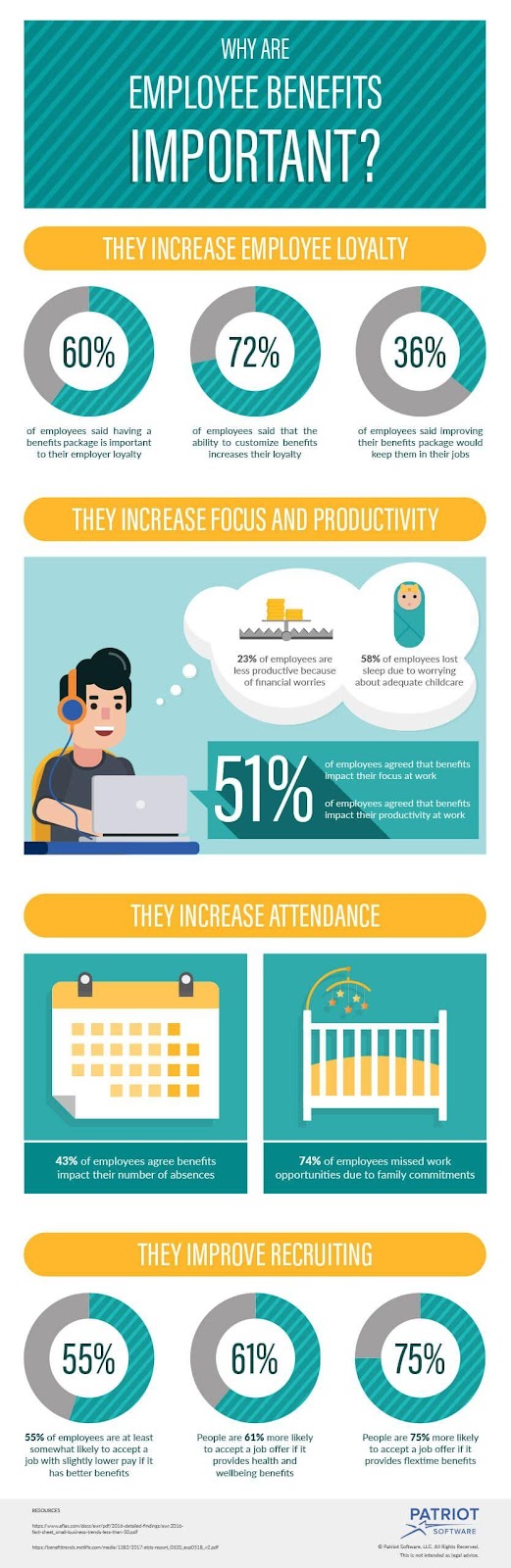
source: Patriot Software
Multiple studies and surveys have indicated that a majority of salaried employees prefer better benefits and perks over a pay raise:
A 2016 survey by Aflac found that having a benefits package is extremely or very important to their employer loyalty for 60% of employees. According to the same survey, 36% of employees say improving their benefits package is one thing their employers can do to keep them in their jobs.
Another survey by MetLife in 2017 indicated that 72% of employees said that the ability to customize benefits increases their loyalty – meaning that employees prefer to choose benefits to match their lifestyles.
Of course, this leads to lower attrition, amongst many other business advantages – such as better productivity, and better attendance. Finances, family commitments, and health issues are the major reasons for absenteeism, and these can be taken care of via benefits like flexible work hours and health benefit plans.
Benefits Desirable in Today’s Age
While some benefits of earlier times are no longer popular, some are given a great deal of importance. These benefits include:
Medical Insurance
With medical costs skyrocketing globally, health insurance and medical benefits are becoming increasingly important to many. These are one of the most expensive benefits to provide, but they remain the most desired for employees.
Retirement Plans
The youth of today are increasingly aware of their future and wish to start their retirement plan as soon as possible, understanding that it is important to ensure survival when they can’t earn anymore. So attractive retirement plans are quite important as benefits go.
Paid Leaves
Increased vacation time and more paid leaves per year are certainly desirable to employees, with breaks a necessity rather than a benefit due to increased stress at the workplace. Of course, a lot of executives end up leaving vacation days unused. In such cases, employees can either carry forward their leave days into the next year or opt to cash-in on their leaves, depending on the company policy.
The above benefits have been around for a while, and are still important to employees. However, with the changing times, many new benefits have been introduced, the most desirable among them including:
Flexible Work Arrangements
Flexible work arrangements have only become feasible due to recent tech advances. With meetings possible through video conferences and clients just a call away, it’s become possible to only turn up for work when needed and spend unproductive work time doing something productive at home. Similarly, working from home is also possible in some professions, and these are the benefits many employees look for and even prefer over a higher salary package.
Fitness-related Benefits
With increasing importance accorded to stress relief and relaxation, workplaces have become more interesting and colourful, with places for fun and games, and even full-fledged gyms. As part of stress relieving initiates at workplaces, many employees desire yoga or fitness sessions, or well-equipped gyms at the office.
Student Loan Assistance
Education costs are now hitting the roof, and most students try to meet these costs by taking loans. While a high salary would definitely help to pay off these loans, freshers prefer loan or tuition assistance over a higher paying job. Providing such benefits might be costly, but companies can use it to their advantage and avail tax benefits on tuition fee provided to employees. Services like School FeEs from Fibe are tuned to meet exactly these needs.
Financial Wellness
Investment is an significant factor in building one’s savings, and the youth of today is realising this fact faster than previous generations. However, a large number of people remain financially unaware and have no clear ideas as to where to invest or what kind of investment would bring them the best returns. In this situation, a benefits package which includes financial advice, investment assistance and help in financial management is highly desirable.
In today’s fast-paced digital age, employers making work easy for them is accorded a higher priority rather than a higher salary, although good pay certainly remains desirable. Work-life-balance, as well as the reduction of some of its related stress through financial benefits plans, are coveted perks in the markets. Further, employees also like to be cared for, and attractive benefits packages show that the employers care. Employee benefits are, therefore, very important to attract and retain a skilled workforce.
We have all, at some point in our lives, come across theories or studies raising questions about what motivates employees and have, more often than not, found the answers to be money and job security. None of these studies, however, can be expected to be 100% accurate because every individual is different and so is what motivates them.
It is also not easy for an organization to understand such individual motivations, especially with a new generation of millennials who desire more than just monetary compensation or the security of a job – attributes which were, without a doubt, highly valued by their predecessors. That does not mean that they consider these attributes unimportant. While they definitely feature high on the pyramid, there’s plenty more that’s joining the queue.
The first of the many changes in employee attitudes is that individuals today desire happiness from their jobs rather than looking at it simply as a source of earning. With the increasing tech advancements, machines are being employed to complete the routine activities and humans are left to follow their passions. Employees are becoming increasingly particular about the job roles they adopt and want to ensure that it gives them a sense of contribution and satisfaction. They are willing to invest in developing their skills and to learn new job aspects to help them remain relevant to their job roles.
The second change, which is in turn an influence on job satisfaction, is the need to be respected. Employees of the current generation no longer want to be treated as novices or be beaten down simply because the person on the opposite side is several levels higher in the organizational hierarchy. This does not mean that they are arrogant or overconfident – they seem to be simply looking for fair treatment. Millennials understand the importance of experience and are willing to learn from those who have been at the job longer than them provided they are recognized for their superior work and individual talents in concrete ways.
The third change that has come about is the desire for work-life balance. Individuals today are no longer getting married at an early age which leaves them with a source of income minus the responsibilities of family life. This combined with the increasing number of entertainment options is improving what is commonly known as the ‘social life’ and ‘experience building’ of an individual. Read more about millenial spending trends here and here.
Today’s employees want to spend just as much time watching an episode of Game of Thrones or going on a solo backpacking trip across Europe (did I mention you could avail instant cash loans for travel purposes from Early Salary?), as they do looking at a spreadsheet in office. Add to that the daily traffic congestion that lines every metropolis during commutes, and you have a whole huge bunch of people preferring to work from home whenever possible.
The fourth change is the desire to control their work methods. Employees today want to be able to decide themselves how, where and when the work gets done. This is not to say that they shy away from deadlines or compromise on the quality of the work but is more about the autonomy they seek to be able to decide whether the work takes two hours or two days and to judge themselves whether the output they are giving is the best they can do.
These changes, though not exhaustive, are some of the most significant observations among the millennial employees. They are also a common reason why many from this generation today are seeking entrepreneurial activities and unconventional careers despite the high risks involved rather than the evergreen pastures of a 9 to 5 job. For leaders wanting to retain their best talent, starting to streamline compensation, benefits and work style to accommodate these changes would be a wise move and go a long way in attracting and retaining the current crop of enthusiastic and bright millennials.